
Colombia’s most spectacular meeting of jungle and Caribbean Sea — everything you need to visit, plan, and experience Tayrona National Park.
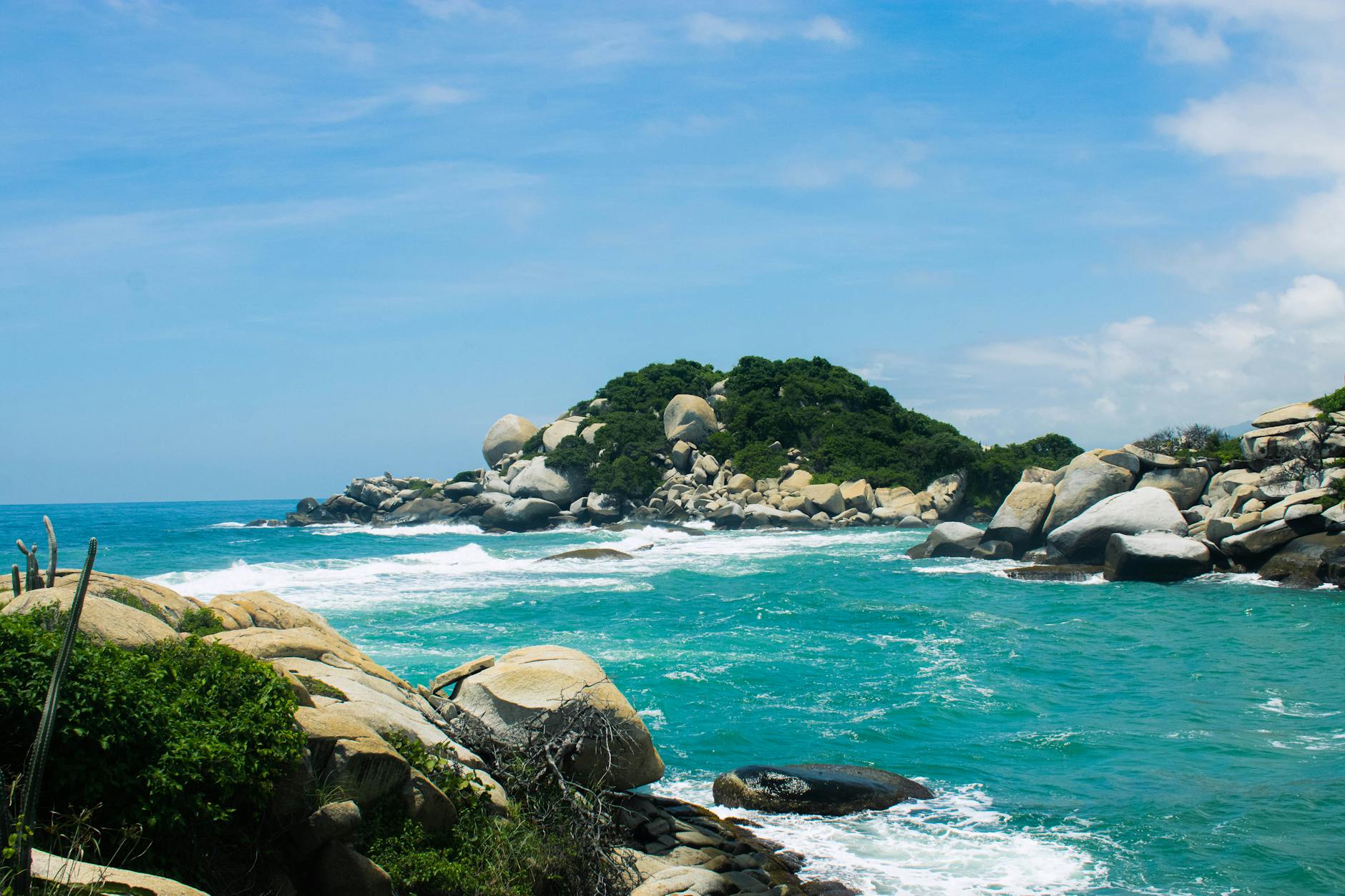
There is a moment in Tayrona National Park that every visitor remembers. You’ve been walking for 45 minutes through dense tropical jungle — howler monkeys crashing through the canopy above, iridescent butterflies crossing the path — and then the trees open, the sound of waves arrives before the view does, and suddenly you’re standing above a Caribbean bay so perfectly formed it looks like something a painter invented. Turquoise water, white sand, granite boulders the size of houses, and jungle pressing right to the waterline.
That moment is why Tayrona exists at the top of every Colombia itinerary, and why this guide exists to help you experience it properly.

Tayrona National Natural Park (Parque Nacional Natural Tayrona) protects 150 square kilometres of one of the most biologically diverse coastlines in South America — where the Sierra Nevada de Santa Marta mountains meet the Caribbean Sea in an extraordinary collision of ecosystems. Pre-Columbian settlements, howler monkey troops, coral reefs, and some of Colombia’s finest beaches coexist within a park that receives over 200,000 visitors a year yet still manages to feel genuinely wild in its interior.
This complete Tayrona National Park guide covers everything: how to get there, the best beaches, where to stay inside the park, which trails to hike, what wildlife to expect, when to visit, and the practical details that separate a good Tayrona day trip from an unforgettable multi-day experience.

Why Tayrona National Park Is Worth the Hype
Travel blogs have a habit of overpromising. Tayrona is one of the rare destinations that doesn’t just meet the hype — it consistently exceeds it. Here’s what makes it genuinely special:
The landscape combination is unique. You won’t find this anywhere else in South America: snowcapped peaks (the Sierra Nevada de Santa Marta, the world’s highest coastal mountain range, rises to 5,775 m just 42 km from the sea), tropical dry forest, tropical wet forest, cloud forest, mangroves, coral reefs, and Caribbean beach all within the same protected area. The visual drama of forest-to-beach is unlike anything in the region.
The wildlife is everywhere and unafraid. Howler monkeys wake you before dawn with a sound that falls somewhere between a roar and a foghorn. Spider monkeys swing through the canopy above the main trails. Capuchin monkeys raid the camp kitchens if you leave food out. Toucans perch in full view. Iguanas sun themselves on the boulders above the water. Tayrona has one of the highest primate densities in Colombia’s Caribbean region.
The beaches are genuinely extraordinary. Cabo San Juan — the park’s most famous beach — is a perfect bay of white sand, turquoise water, and massive granite boulders, framed by jungle on three sides and open to the Caribbean on the fourth. It’s not just one of Colombia’s finest beaches. It’s one of the finest in South America.
The pre-Columbian history runs deep. The entire Sierra Nevada de Santa Marta was the homeland of the Tairona people, one of the most sophisticated pre-Columbian civilisations in northern South America. Evidence of their settlements, roads, and terracing is visible throughout the park, and the indigenous Kogi, Arhuaco, and Wiwa communities — their direct descendants — still live in the Sierra Nevada today.

Where Is Tayrona National Park?
Tayrona sits on Colombia’s Caribbean coast in the Magdalena Department, immediately east of the city of Santa Marta. The park’s western boundary begins roughly 34 km east of Santa Marta’s city centre, and it extends east along the coast toward the town of Palomino.
The main entrance is at El Zaino, on the main coastal highway (Troncal del Caribe) between Santa Marta and Riohacha. All visitors, day-trippers, and overnight guests enter here. There is a second entrance at Calabazo on the western edge, used primarily for the Ciudad Perdida (Lost City) approach and by organised tours — it’s not the standard visitor entrance.
Coordinates: El Zaino entrance: 11°18′N 73°54′W
Distances from major cities:
- Santa Marta city centre: 34 km (45 min by bus or taxi)
- Cartagena: 230 km (3.5–4 hours by bus)
- Barranquilla: 195 km (3 hours by bus)
- Bogotá: 970 km (1.5h flight + transfer)
- Medellín: 780 km (1h flight + transfer)
Getting to Tayrona National Park
From Santa Marta
Santa Marta is the base for visiting Tayrona and the city you’ll use for all transport connections. From Santa Marta, you have three options:
Bus (cheapest — $1–2): Minibuses and collectivos bound for Riohacha and Palomino depart from the intersection of Carrera 11 and Calle 11 in Santa Marta’s market area. Tell the driver you’re going to Tayrona or El Zaino — they’ll drop you at the park entrance. Journey: 45–60 minutes. Departures every 15–20 minutes from early morning.
Taxi (most convenient — $15–25): A private taxi from Santa Marta to El Zaino takes 40–45 minutes and can be arranged through your hotel or hailed from the market area. Negotiate the price before getting in. Taxis cannot enter the park — they drop you at El Zaino and you proceed on foot or by park bus.
Tour from Santa Marta or Cartagena ($25–60 per person): Most hostels and tour agencies in Santa Marta offer day trips to Tayrona including transport, park entry, guide, and sometimes lunch. Practical for day-trippers who don’t want to manage logistics independently. Not recommended for overnight stays — you’ll want more flexibility.
From Cartagena
The most common route for international tourists is Cartagena → Santa Marta → Tayrona. From Cartagena:
Bus (3.5–4 hours · $10–20): Marshell, Berlinas del Fonce, and Copetran all run comfortable direct services from Cartagena’s bus terminal to Santa Marta. Departures throughout the day. From Santa Marta, continue to El Zaino as above.
Flight (45 min · $50–120): Fly Cartagena (CTG) to Santa Marta (SMR) with LATAM or Avianca. Santa Marta’s Simón Bolívar Airport is 20 km from the city centre and 54 km from the park entrance.
Inside the Park: From El Zaino to the Beaches
After entering at El Zaino and paying your entrance fee, you have two options for getting to the beaches:
Park bus (chiva — $3): A traditional open-sided Colombian bus runs from El Zaino to the Cañaveral area (beach zone), taking 20 minutes on a dirt road through the park. Departures roughly every 30–45 minutes, 8 AM to 5 PM. This drops you at the start of the beach trail network.
Walk: The trail from El Zaino to Cañaveral takes approximately 1.5–2 hours through forest. Hot and humid — most visitors take the bus.

Tayrona National Park Beaches: Complete Guide
The park’s coastline stretches for roughly 35 km, but visitors access five main beach areas. From west to east:
🏖️ Arrecifes
The first major beach you reach after Cañaveral, about 45 minutes on foot from the park bus drop-off. Arrecifes is dramatic — massive granite boulders, powerful surf, deep turquoise water against white sand. It is also extremely dangerous for swimming. Strong rip currents and underwater rock formations make swimming here genuinely life-threatening. Deaths occur here every year. Arrecifes is for walking, photographing, and absorbing the scale of the landscape — not for entering the water.
Key info: 45 min walk from Cañaveral. No swimming. Camping and accommodation available (Ecohabs).
🏖️ La Piscina
A 10-minute walk east of Arrecifes, La Piscina (“The Pool”) is the first safe swimming beach you reach. A natural rock formation creates a sheltered lagoon of calm, clear water — the only beach in this zone where swimming is consistently safe. Snorkelling is good here too. It gets crowded by midday on weekends and in high season.
Key info: Safe swimming. Snorkelling. Gets busy. No accommodation — day visitors only.
🏖️ Cabo San Juan del Guía ⭐ Best Beach
The crown jewel of Tayrona and one of the finest beaches in South America. A 1.5–2 hour walk from Cañaveral (or 45 minutes from Arrecifes), Cabo San Juan is a perfect bay of white sand divided by a large granite headland into two distinct coves — one calmer and safe for swimming, one more exposed and dramatic for watching waves crash over the boulders.
What makes Cabo San Juan extraordinary is not just the beach itself but its setting: jungle pressing to the waterline on both sides, massive boulders rising from the sand like sculptures, the Caribbean impossibly blue beyond the headland, and the constant background noise of howler monkeys and macaws. At dawn, before the day-trippers arrive, it is one of the most beautiful places in Colombia.
Swimming: The western cove (facing left as you arrive) is generally calmer and safer. The eastern cove is more exposed — check with park rangers before entering. Current strength varies with season.
Key info: 1.5–2h walk from Cañaveral. Best swimming is in the western cove. Hammock camping, tent camping, and Ecohab accommodation available on-site. The most popular overnight destination in the park.
🏖️ Playa Brava & Playa del Muerto
East of Cabo San Juan, a 30-minute hike over a rocky headland brings you to Playa Brava — wild, wave-pounded, completely undeveloped, and almost always deserted. Swimming is dangerous here but the solitude is extraordinary. Continue another 20 minutes for Playa del Muerto (Playa Nudista), a clothing-optional beach with a slightly sheltered bay. Both are visited by a fraction of Tayrona’s total visitors — if you want solitude, head here.
Key info: 30–50 min east of Cabo San Juan. Difficult to reach. No facilities. No safe swimming.
🏖️ Playa Cristal (Bahía Concha)
On the western edge of the park, accessible via a separate entrance or boat from Santa Marta’s port, Playa Cristal is the best snorkelling beach in Tayrona. The water here is calmer and clearer than the eastern beaches, with coral formations just offshore and abundant fish. It’s also significantly less crowded than Cabo San Juan. Day trips by boat from Santa Marta can be arranged through your hotel for $20–35 per person.
Key info: Western edge of park. Best for snorkelling. Accessible by boat from Santa Marta. Less crowded than the main park circuit.
Tayrona Hiking Trails
Main Trail: El Zaino → Cañaveral → Arrecifes → La Piscina → Cabo San Juan
Distance: 7 km · Time: 3–4 hours one way · Difficulty: Easy to Moderate
The park’s main visitor trail runs from the Cañaveral area east to Cabo San Juan, passing Arrecifes and La Piscina en route. The terrain is relatively flat, the trail is well-marked, and the walking surface varies between sandy path, rocky sections, and slippery stone creek crossings. Boots or sturdy sandals recommended — flip-flops are genuinely inadvisable on the rocky sections.
The trail passes through patches of tropical dry forest, secondary jungle, and open coastal scrub. Wildlife sightings are common throughout — howler monkeys are almost guaranteed, spider monkeys are frequent, and capuchins are regular visitors around Arrecifes camp.
Trail hours: Open 8 AM to 3 PM (last entry). You must be back at El Zaino by 5 PM. Do not attempt the trail after 2 PM if doing a day trip — you won’t make it back to the entrance in time.
Pueblito Trail: Cabo San Juan → Pueblito → Calabazo
Distance: 4 km (Cabo San Juan to Pueblito) · Time: 2–3 hours each way · Difficulty: Moderate to Difficult
The most rewarding hike in the park leads from Cabo San Juan up into the Sierra Nevada foothills to Pueblito — a partially excavated pre-Columbian Tairona village of stone terraces, ceremonial paths, and ancient residential structures set in cloud forest at around 300 metres elevation. The hike climbs steeply through dense jungle, requiring good fitness and proper footwear.
Pueblito offers a profound connection to the Tairona civilisation that predates European contact by over a thousand years. The stone pathways, drainage channels, and terraced agricultural platforms are extraordinarily well-preserved. Indigenous Kogi and Arhuaco people occasionally visit the site, which remains sacred to them.
From Pueblito you can either return to Cabo San Juan (recommended) or continue to the Calabazo entrance on the main highway — 3 km downhill on a different trail, where you can catch a bus back to Santa Marta.
Recommended for: Overnight visitors who can start early (before 8 AM) and spend 5–6 hours on the trail. Not suitable for day-trippers from Santa Marta.

Where to Stay in Tayrona National Park
Inside the Park
Ecohabs (Glamping Cabins) The park’s signature accommodation: circular wooden cabins elevated on platforms in the jungle or above the beach, with beds, mosquito nets, and basic bathrooms. They are romantic, rustic, and the only solid-wall accommodation inside the park. Located at Cañaveral (near the beach bus drop-off) and at Cabo San Juan.
Prices: 180,000–350,000 COP per night ($45–90 USD) depending on location and season. Book well in advance for December–January and June–August — these sell out weeks ahead. Book through the official Aviatur concession: aviaturecohabs.com.
Hammock Camps The most popular budget option and genuinely the most fun way to sleep in Tayrona. Hammocks strung under thatched palapas at Cabo San Juan and Arrecifes, 2–5 metres from the beach, with mosquito nets provided. You sleep to the sound of the sea and wake with the howler monkeys.
Prices: 40,000–60,000 COP per night ($10–15 USD). Blankets available for rent (nights are warmer than you expect but can feel cool after midnight). Bathroom facilities are basic but functional.
Tent Camping Several designated camping areas through the park offer flat ground for your own tent or rental tents. Basic bathroom facilities. Less atmospheric than hammocks but more privacy.
Prices: 30,000–50,000 COP per night ($8–13 USD). Tent rental available if you don’t have your own.
In Santa Marta (Base Camp)
Santa Marta is the most practical base for day trips and for the night before and after a Tayrona stay. The city has accommodation for every budget.
Budget ($15–40/night): The Dreamer Hostel — Santa Marta’s most popular backpacker hostel, pool, social atmosphere, excellent location. Masaya Santa Marta — boutique hostel in the historic centre, excellent design, rooftop bar.
Mid-range ($50–120/night): Hotel Boutique Don Pepe — charming colonial-style hotel in the historic district, excellent value. Zuana Beach Resort — beachfront, slightly outside the centre, ideal if you want beach access in Santa Marta itself.
Luxury ($150–350+/night): La Ballena Azul — the finest boutique option in Santa Marta, restored colonial house in the old city. Teyuna Tayrona Eco-Resort — just outside the park boundary, the most luxurious option near the park.
Tayrona Wildlife Guide
Tayrona is one of the most biodiverse national parks in Colombia’s Caribbean region. These are the species you’re most likely to encounter:
Primates
Howler Monkeys (Mono Aullador) — Your alarm clock in Tayrona. The sound of a howler monkey troop at dawn — a deep, resonant roar that carries for kilometres — is one of the defining sounds of the park. They’re large (up to 9 kg), move slowly, and spend most of their time in the upper canopy. Look up in the mornings along the main trail. You’ll hear them long before you see them.
White-Headed Capuchin Monkeys — Small, quick, intelligent, and bold. Capuchins are the monkeys most likely to raid your food — never leave snacks unattended at camp. They travel in troops of 10–20 and will descend from the canopy to investigate anything interesting at ground level. Highly entertaining to watch; problematic if you’re the one losing lunch.
Spider Monkeys (Mono Araña) — Long-limbed and extraordinarily graceful, spider monkeys swing through the canopy in a fluid, almost boneless movement. They’re shyer than capuchins and prefer undisturbed forest. The trail between Arrecifes and Cabo San Juan offers the best spider monkey sightings.
Birds
Tayrona sits within one of the most important bird corridors in northern South America, with over 300 recorded species. Highlights include toucans (most commonly the Keel-billed Toucan), frigatebirds soaring above the coast, pelicans diving in the bays, multiple species of parrot and macaw, and the extraordinary Santa Marta parakeet, found only in the Sierra Nevada de Santa Marta.
Reptiles
Iguanas are everywhere — basking on boulders, on trail markers, on the rooftops of the Ecohabs. The green iguana can reach 2 metres in length and is completely unperturbed by human presence. Snakes are present in the forest (including some venomous species) but rarely encountered on the main trails. Shake out boots left outside overnight.
Marine Life
The coral reefs off Playa Cristal and sections of the eastern coast host sea turtles, barracuda, parrotfish, sergeant majors, and occasional reef sharks. Hawksbill turtles nest on the park’s beaches between August and December. If you encounter a turtle nesting, keep distance and no flash photography.
Best Time to Visit Tayrona National Park
☀️ Dry Season (December to April) — Peak Season
The Caribbean coast’s dry season brings hot, sunny days with minimal rainfall, calm seas, and the best conditions for swimming and snorkelling. December–January is the absolute peak — Colombian school holidays, international visitors, and the park at maximum capacity. Accommodation books up weeks in advance. Expect larger crowds at Cabo San Juan and La Piscina.
Best for: First-time visitors, beach activities, snorkelling, photography. Book all park accommodation 4–6 weeks ahead in December–January.
🌧️ Wet Season (May to November) — Low Season
The wet season brings afternoon rains (typically 2–4 hours, not all-day downpours), lushly green vegetation, and significantly fewer visitors. The forest is at its most vibrant and wildlife activity increases. Trails can be muddy and slippery after rain — proper footwear is essential.
The park closes annually for ecological recovery, typically for several weeks in February and in June. Check the current closure dates at parquesnacionales.gov.co before booking — a closed Tayrona is a wasted trip.
Best for: Budget travellers, wildlife watching, photography of the lush green landscape, avoiding crowds. Accommodation is available without advance booking in most of the wet season.
🌤️ Shoulder Season (April–May and October–November) — The Sweet Spot
Lower crowds than peak season, lower prices, and generally reasonable weather. Late April and early May are particularly pleasant — the vegetation is still green from the wet season, the seas are calm, and you can walk the Cabo San Juan trail without fighting through tour groups.
Our recommendation: Visit in late April/early May or October for the best balance of conditions, availability, and price.
Tayrona National Park Itinerary
Day Trip (Minimum — not recommended)
6:30 AM — Leave Santa Marta by bus or taxi 7:30 AM — Arrive El Zaino, pay entrance fee, take park bus to Cañaveral 8:30 AM — Begin walking the main trail toward Cabo San Juan 10:30 AM — Arrive Cabo San Juan. Swim, eat, rest 12:00 PM — Begin return walk to Cañaveral 2:30 PM — Catch park bus back to El Zaino 3:30 PM — Bus or taxi back to Santa Marta
Honest assessment: A day trip gives you the main experience but leaves no time for Pueblito, wildlife at dawn, or truly experiencing the park without crowds. If day trip is your only option, it’s worth doing — but two nights is transformative.
2-Night Stay (Recommended)
Day 1: Leave Santa Marta by 8 AM. Enter El Zaino. Take park bus to Cañaveral. Walk the main trail at a relaxed pace — wildlife watching, photography, swimming at La Piscina and Cabo San Juan. Check into hammock camp or Ecohab at Cabo San Juan. Dinner at the beach restaurant. Sleep to the sound of waves.
Day 2: Wake at dawn for howler monkey chorus and the beach before day-trippers arrive. Hike to Pueblito in the morning (6 AM start recommended — the trail is cooler and the forest more active). Return to Cabo San Juan for afternoon swimming and rest. Sunset from the granite boulders above the western cove.
Day 3: Second dawn at Cabo San Juan. Walk back to Cañaveral at a leisurely pace. Park bus to El Zaino. Bus or taxi back to Santa Marta by noon.
3-Night Stay (For Wildlife & Exploration)
Add a third night at Arrecifes (different camp, different beach atmosphere) and a boat day trip to Playa Cristal for snorkelling. Visit Playa Brava and Playa del Muerto for solitude. The extra day transforms Tayrona from a “beach visit” into a genuine nature immersion.
Tayrona National Park Practical Tips 2026
Book accommodation well in advance. Ecohabs sell out 3–4 weeks ahead in peak season (December–January, June–August). Hammock camps have more capacity but fill up on weekends and Colombian holidays year-round. Book at aviaturecohabs.com for Ecohabs; hammock camps can be booked on arrival but it’s risky in peak season.
Check closure dates before you go. Tayrona closes for ecological recovery — approximately February 1–15 and the first two weeks of June. Dates change slightly each year. The official source is parquesnacionales.gov.co. A closed park means a wasted trip.
Bring cash. There are no ATMs inside the park. Bring enough Colombian pesos for entrance fees, accommodation, food, and emergencies. The park restaurants accept cash only. Withdraw in Santa Marta before you go.
Water and food. Carry at least 2 litres of water for the trail — the heat and humidity will dehydrate you faster than you expect. Food stalls and basic restaurants operate at Arrecifes and Cabo San Juan (arroz con pollo, arepas, fish, cold beer). Prices are higher than Santa Marta. Bring snacks for the trail.
What to pack:
- Sturdy hiking shoes or sandals with grip (not flip-flops)
- Lightweight rain jacket
- High-SPF reef-safe sunscreen
- Insect repellent (DEET or picaridin — mosquitoes are active at dusk and dawn)
- Dry bag or waterproof phone case
- Headlamp for the campsite at night
- Cash in Colombian pesos
- Your own snorkelling gear if you have it (rental available at Playa Cristal)
Never swim at Arrecifes. The current statistics are grim — multiple deaths per year at this beach. Regardless of how calm it looks, how many other people are in the water, or what anyone tells you, do not swim at Arrecifes. La Piscina (10 minutes east) is safe. Cabo San Juan’s western cove is generally safe. Arrecifes is not.
Wildlife rules:
- Never feed the monkeys — it creates dependency, causes aggression, and makes them sick
- Never touch the coral reefs
- Keep distance from nesting turtles (August–December)
- Don’t remove shells, rocks, or plants
- Keep food sealed in your tent or hammock area at all times
Leave the park by 5 PM. The park strictly enforces its closing time. Day visitors who aren’t staying overnight must be back at El Zaino by 5 PM. Missing this means a significant fine and a very unpleasant interaction with rangers.

Tayrona & the Tairona People
The park is named after the Tairona civilisation — one of the most sophisticated pre-Columbian cultures in northern South America. The Tairona inhabited the Sierra Nevada de Santa Marta from approximately 200 CE until the Spanish conquest, building an extraordinary network of stone cities, roads, agricultural terraces, and drainage systems across the mountain range.
Their most famous city, Ciudad Perdida (Teyuna) — the Lost City — sits 1,200 metres above sea level deep in the Sierra Nevada, accessible only via a 4-day jungle trek. It predates Machu Picchu by approximately 650 years and is considered one of the finest pre-Columbian sites in South America.
Within Tayrona itself, Pueblito — accessible via the trail from Cabo San Juan — is a partially excavated Tairona settlement with circular stone platforms, ceremonial paths, and residential terraces. Walking among these structures in the forest, several hundred years after they were last inhabited, is a profound experience.
The Tairona’s direct descendants — the Kogi, Arhuaco, Wiwa, and Kankuamo peoples — still inhabit the Sierra Nevada today. They are extraordinarily private communities with a deep spiritual relationship with their ancestral land, including the park. If you encounter members of these communities on the trails, treat them with complete respect: no unsolicited photographs, no intrusive questions, no entering their spaces without invitation.
Tayrona National Park FAQ
Is Tayrona National Park worth visiting?
Unreservedly yes. Tayrona consistently ranks among the top five attractions in Colombia and among the finest national parks in South America. The combination of wildlife, pre-Columbian history, and extraordinary beaches is available nowhere else in Colombia. Even visitors who have seen other Caribbean destinations describe Tayrona as something different — more raw, more complete, more alive.
How many days should I spend in Tayrona?
A minimum of two nights inside the park. One night gives you one morning at Cabo San Juan before the crowds arrive — better than a day trip, but you’ll leave wanting more. Two nights allows the Pueblito hike, two dawns at the beach, and a genuine sense of the park’s rhythm. Three nights is ideal for wildlife, snorkelling at Playa Cristal, and exploring the eastern beaches.
Can I visit Tayrona National Park as a day trip?
Yes, but with caveats. A day trip gives you 4–5 hours at the beaches if you leave Santa Marta by 7:30 AM and must return by 5 PM. You’ll see Cabo San Juan and can swim at La Piscina. You won’t have time for Pueblito, Playa Brava, or the eastern beaches. The experience is significantly inferior to staying overnight — the best moments in Tayrona happen at dawn and dusk, when day-trippers aren’t there.
When is Tayrona National Park closed?
The park closes for ecological recovery approximately twice a year — generally two weeks in February and two weeks in June. Exact dates change annually. Always verify at parquesnacionales.gov.co before booking travel. Entering during a closure is not possible — park rangers strictly enforce the closure.
Is it safe to swim at Tayrona’s beaches?
Some beaches are safe; others are genuinely dangerous. Never swim at Arrecifes — strong currents and underwater rocks cause deaths every year. La Piscina is safe (sheltered lagoon). Cabo San Juan’s western cove is generally safe — check with rangers on the day. Playa Cristal is the calmest water in the park. When in doubt, ask park rangers before entering the water.
How much does it cost to visit Tayrona?
Entry fee: 59,500 COP (~$15 USD) for foreign visitors in 2026. Accommodation inside the park ranges from 30,000–40,000 COP ($8–10) for tent camping to 40,000–60,000 COP ($10–15) for hammocks and up to 350,000 COP ($90) for Ecohabs. Food in the park runs 15,000–30,000 COP ($4–8) per meal. A two-night trip inside the park, including transport from Santa Marta, accommodation (hammock), food, and entry, costs roughly $60–100 per person at the budget end.
Do I need a guide for Tayrona?
Not for the main trails (El Zaino to Cabo San Juan). The path is well-marked and safe for independent hikers. A guide is strongly recommended for the Pueblito trail — the path is less clearly marked in sections and a guide adds enormous historical context to the site. Ask at the park entrance or at your accommodation in the park for recommended guides ($30,000–60,000 COP for a half-day).
How to Combine Tayrona with a Colombia Itinerary
Tayrona fits naturally into a Colombia coastal itinerary:
From Cartagena: Take the bus to Santa Marta (3.5–4 hours), spend a night in the city, then head into Tayrona for 2–3 nights. Return to Santa Marta and either continue along the coast or fly back to Bogotá or Medellín.
From Medellín or Bogotá: Fly to Santa Marta (SMR) directly — both LATAM and Avianca serve the route. From the airport it’s 45 minutes to El Zaino.
The Colombia 10-Day Itinerary extension: If you’re doing the standard Colombia circuit (Bogotá + Medellín + Cartagena), add 2–3 days to the end of your trip for Tayrona and Santa Marta. It rounds off the itinerary perfectly — you finish the country on a Caribbean beach surrounded by howler monkeys, which is a very good way to finish a country.
The Lost City connection: The most immersive Colombian experience combines Tayrona (2 nights) with the Ciudad Perdida trek (4–6 days). Start in Santa Marta, spend two nights in the park, then join a Lost City trek departing from Santa Marta. This 8–9 day circuit is one of the finest adventure travel experiences in South America.
Ready to Visit Tayrona National Park?
Tayrona rewards the visitor who slows down. Walk the trail without checking the time. Stop when the howler monkeys start calling and look up until you find them in the canopy. Sit on the granite boulders above Cabo San Juan and watch the afternoon light change on the water. Start the Pueblito trail before dawn and arrive at the stone terraces in the early morning mist.
This is a park that reveals itself in layers — the beach first, then the forest, then the animals, then the history beneath the roots and the stones, then the living communities who still call this mountain range their home. None of those layers are available in a day trip.
Give it time. It will give back more than you brought.


